
AI Tools Open the Door to Self-Management
Nicole Mundy

Large-scale, extended workforce management can be a complex and intricate process. To navigate complicated compliance rules and regulations, increased need for visibility and narrowed avenues to talent, companies can now utilize emerging AI technologies that enable them to bring their extended workforce programs in-house to become self-managed.
In our latest white paper, we examine the growing trend of self-management and outline:
- Why organizations choose to self-manage their extended workforce programs
- Challenges to consider when contemplating a self-managed program
- How to prepare your in-house team to develop an effective extended workforce process
- Recommended approaches for implementing a self-management program
- Guides for achieving and maintaining long-term success with a self-managed program
Why Self-Management Is Appealing
While the reasons for self-management are varied, primarily companies view it as a cost-saving opportunity, a security measure or a way to control strategic alignment.
By managing contingent and freelance engagement in-house, organizations can control costs and find placement partners that match the budget allotted by their company. Having a centralized department for contingent workforce management provides a team of people who can stay up to date on the various regulations and governances for where your workforce is located. This can ensure compliance remains in your control.
Companies that need to maintain high levels of security may find self-management reassuring, as all people working on their systems and accessing their tech stack are full-time employees (FTE). Accessing tech that provides full visibility of contingent workers, gathering data, monitoring compensation and measuring which actions yield results that achieve business goals.
Self-management can also ensure that the skills sourced match the work that your leadership believes is aligned to business needs. Through a well-developed strategic extended workforce plan a self-managed process your program leaders can constantly monitor business needs and shift talent needs to match.
To position your company to benefit from these potential outcomes, it is critical to consider all key risk factors, develop a thorough strategy and develop an in-depth business case to ensure leadership buy-in. In addition, having someone on staff who is knowledgeable of the latest technologies and can stay consistently informed of the rapidly changing workforce tech tools will be essential.
Careful Planning Can Lower Risks
According to this report from the Massachusetts Institute of Technology, 95% of businesses have received zero ROI with generative AI. The reason cited by many is that the orchestration of the tools was not properly planned out.
This spotlights the importance of research, preparation and a strategic approach before acquiring AI tools and setting out to develop a self-managed program. In the research outlined in our report, we discovered several successful programs started by partnering with an experienced company to guide them through initiating a self-management plan. This approach can help address some of the key challenges faced by self-management:
- Risk Management: Understanding the laws, regulations, tax codes, etc. that govern engagement with the extended workforce.
- Administrative inefficiency: Extended workforce programs are in a constant state of purchasing and monitoring, creating complex administrative processes.
- Relevant program expertise: Developing a centralized vendor management office to establish the framework, processes and tools that deliver consistent and effective management.
- Technology optimizations and expertise: The knowledge and skillsets to assess the best technologies for your company’s unique needs, as well as the insights to integrate seamlessly with the existing systems.
- Hiring manager adoption: There is a learning curve with employing extended workers that is more complex than with FTE, such as setting up a vendor management system (VMS) for consistent and accurate data capture, adopting and using workforce management systems and distinct complications innate to hiring non-employees.
- Executive Support: Nearly all workforce strategies struggle to succeed without support from the executive level. It is crucial to build a well mapped-out and strategic business case for your program to ensure C-Suite and leadership buy-in.
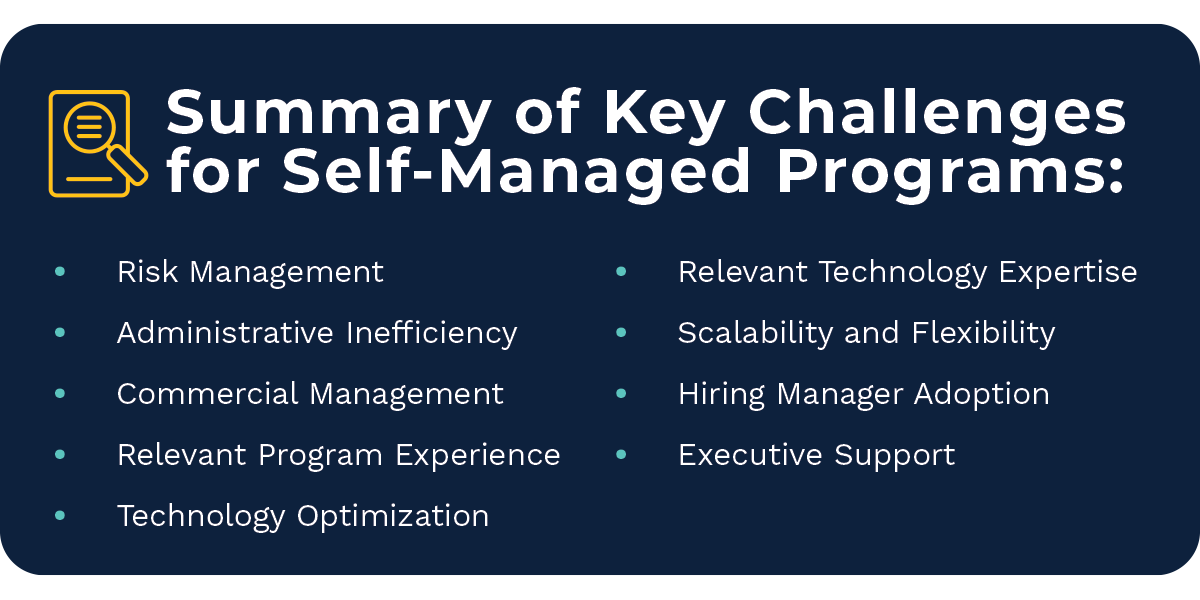
There are several pitfalls to developing a self-managed program, and it may not be as economical as predicted. It is important to consider all aspects of your workforce needs, the long-term view of your company goals and the skills and technologies required to maintain your program.
Making the Advantages of Self-Management a Reality
The interest in self-management continues to grow among global organizations in a variety of fields. Some commonalities among companies experiencing success in self-management include a very large extended workforce spend and very complex program requirements. Organizations in industries with unique workforce challenges, such as retail, healthcare and heavy industrial. Also, businesses where the extended workforce serves a core business role, such as oil and gas have opted for self-management.
These are examples of companies that assessed their workforce needs, their business goals and internal team capabilities and determined that with the right tools, they could self-manage. They also understood the need to strengthen their internal team and processes with the following aspects:
- Program leaders with deep knowledge and experience in extended workforce management
- Large dedicated staff with the right kind of functional and technical expertise, particularly VMS system architects
- Access to data and platforms that MSPs typically provide, such as trade body memberships and labor market compensation data
- Advanced technology features such as AI tools that streamline program operations and improve the adoption of VMS tools and processes, specifically for hiring managers
While many successful organizations choose to engage a third party in the initial stages of program development, companies that strategically approach their self-managed extended workforce processes with leadership buy-in, technological expertise and a risk-management strategy are positioning themselves for positive results with their in-house programs.
Are You Looking to Improve Your Self-Managed Extended Workforce Program?
-
 Reimagining the Talent Experience: A New Operating System for Work
REPORT
Reimagining the Talent Experience: A New Operating System for Work
-
 How Organizations Are Scaling Self-management in Extended Workforce Programs
REPORT
Self-Management in Extended Workforce Programs